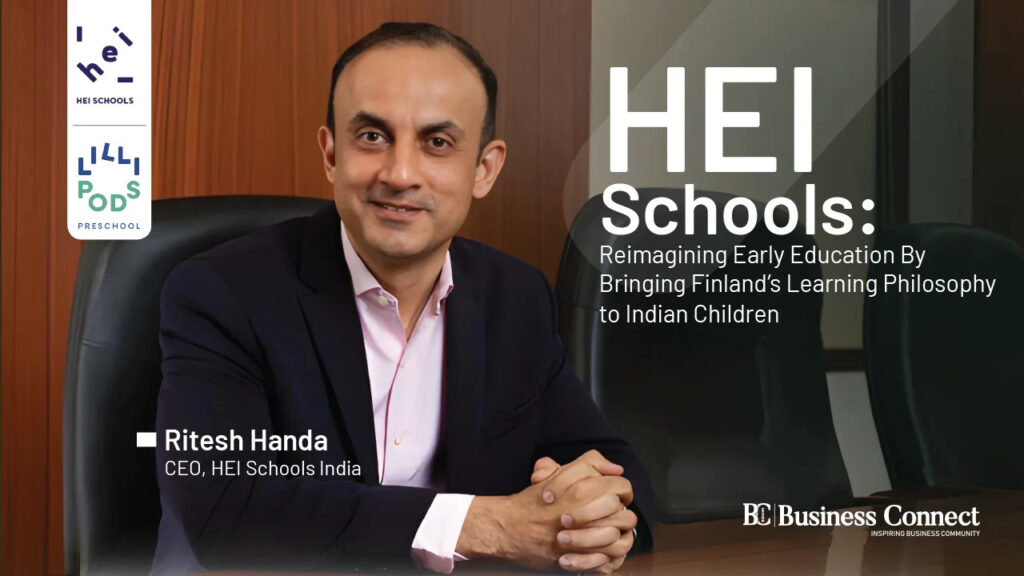
HEI Schools: Reimagining Early Education by Bringing Finland’s Learning Philosophy to Indian Children
Something is changing in Indian parenting. Not long ago, preschool success was measured by how quickly a child could write the alphabet, memorize numbers, or complete worksheets. Today, many parents are beginning to look beyond report cards and classroom performance. They are asking whether their children enjoy learning, whether they feel confident expressing themselves, and whether school is helping them develop as individuals rather than simply preparing them for the next academic milestone.
This shift in perspective is creating space for a new generation of early education providers—schools that prioritize curiosity, creativity, emotional well-being, and independent thinking alongside academic readiness.
Among them is HEI Schools India, an organization bringing Finland’s globally acclaimed approach to early childhood education into the Indian preschool landscape.
Led by education entrepreneur Ritesh Handa, the organization is built on a simple but powerful belief: the early years of a child’s life should be filled with discovery, not pressure.
Rethinking What Early Education Should Look Like
For decades, much of India’s preschool ecosystem has been shaped by early academic expectations. Children are often introduced to structured learning environments at a young age, with success measured through performance and achievement.
However, growing awareness around child psychology and brain development is encouraging parents to view education differently.
Ritesh believes that early learning should focus less on what children can memorize and more on how they learn, communicate, explore, and interact with the world around them.
This philosophy became the foundation of HEI Schools India.
Inspired by Finland’s education model—widely regarded as one of the most child-centric systems in the world—the organization seeks to create classrooms where children learn through play, exploration, collaboration, and real-life experiences.
Rather than placing children under academic pressure from the beginning, the focus is on helping them build confidence, independence, emotional intelligence, and a genuine love for learning.
Bringing Finnish Pedagogy to Indian Families
Finland’s education system has earned global recognition for its emphasis on well-being, creativity, and holistic development. Instead of pushing children toward early academic outcomes, Finnish pedagogy encourages learning through meaningful experiences and age-appropriate exploration.
HEI Schools India has adapted these principles for Indian learners while remaining mindful of local expectations and cultural realities.
The result is an educational approach that balances global best practices with practical relevance.
Classrooms are designed to encourage:
- Play-based learning
- Inquiry and exploration
- Creative expression
- Social interaction
- Problem-solving skills
- Emotional development
Children are encouraged to ask questions, collaborate with peers, and participate actively in their own learning journey.
At the heart of the model lies a belief that learning should be something children look forward to each day—not something they feel pressured to endure.
Building Confident Learners, Not Just High Performers
One of the strongest motivations behind the organization’s vision comes from an observation Ritesh made throughout his years in the preschool sector.
While visiting international learning environments, he noticed that young children often displayed remarkable confidence. They communicated openly, engaged naturally with adults, and expressed their thoughts without hesitation.
In contrast, many academically capable children in India appeared far less comfortable speaking up or interacting independently.
For HEI Schools India, confidence is not viewed as a by-product of education. It is considered a core outcome.
The organization believes that the ability to communicate, collaborate, adapt, and think independently will become increasingly valuable in a rapidly changing world. These skills begin developing long before formal academics take center stage.
As a result, classroom experiences are intentionally designed to nurture self-expression and participation from an early age.
Two Brands, One Educational Philosophy
To serve diverse segments of the Indian market, HEI Schools India currently operates through two preschool brands—HEI Schools and Lillipods.
While each caters to different family needs and investment levels, both remain rooted in the same educational philosophy.
HEI Schools is positioned as a premium offering for families seeking an international early learning experience supported by advanced infrastructure and learning environments.
Lillipods, on the other hand, is designed to make quality, child-centric education accessible to a broader segment of middle-class and upper-middle-class families.
The differences largely lie in operational formats and infrastructure, while the learning philosophy remains consistent across both brands.
For the organization, the objective is not to create different standards of education, but to make meaningful early learning available to different communities.
Creating More Inclusive Learning Spaces
Another area where HEI Schools India stands out is its emphasis on inclusivity.
As conversations around developmental diversity become more prominent, parents are increasingly looking for educational environments that prioritize acceptance and emotional safety.
The organization believes that every child deserves a learning space where individuality is respected and differences are understood.
Its activity-based approach naturally allows for flexibility, reducing the pressure often associated with rigid academic structures.
Rather than focusing on comparison, competition, or rankings, the emphasis remains on participation, exploration, and personal growth.
This philosophy reflects a broader shift taking place across urban India, where emotional well-being is becoming an essential part of educational decision-making.
Innovation with Purpose
Despite its strong focus on human-centered learning, HEI Schools India is also embracing innovation in thoughtful ways.
Technology and AI are being leveraged to strengthen curriculum planning, improve communication with parents, and streamline operational systems.
However, technology is viewed as a support mechanism—not a substitute for meaningful classroom experiences.
The organization remains committed to maintaining screen-light environments where children engage with people, ideas, and experiences rather than excessive digital exposure.
For Ritesh, innovation is valuable only when it creates measurable impact and improves outcomes for children, educators, and families.
A Vision for the Future
Since launching its India operations in late 2025, HEI Schools India has established a presence in cities such as Hyderabad, Gurugram, and Bengaluru.
The ambition, however, extends far beyond geographical expansion.
The organization envisions building nearly 500 schools across India over the next five to six years, bringing Finnish-inspired early childhood education to thousands of families nationwide.
Yet the larger goal is not simply scale.
It is to contribute to a broader transformation in how early education is perceived and delivered in India.
With research showing that the vast majority of brain development occurs before the age of six, the importance of these formative years cannot be overstated. The experiences children have during this period shape not only their academic future but also their confidence, emotional resilience, creativity, and ability to navigate the world around them.
That understanding sits at the heart of HEI Schools India’s mission.
As Indian parents continue to seek educational environments that balance learning with happiness, achievement with well-being, and structure with creativity, HEI Schools is positioning itself at the forefront of a new conversation—one that recognizes that the true purpose of education is not merely to prepare children for school, but to prepare them for life.
Source – https://businessconnectindia.in/hei-schools-finland-education-india/
Related Posts
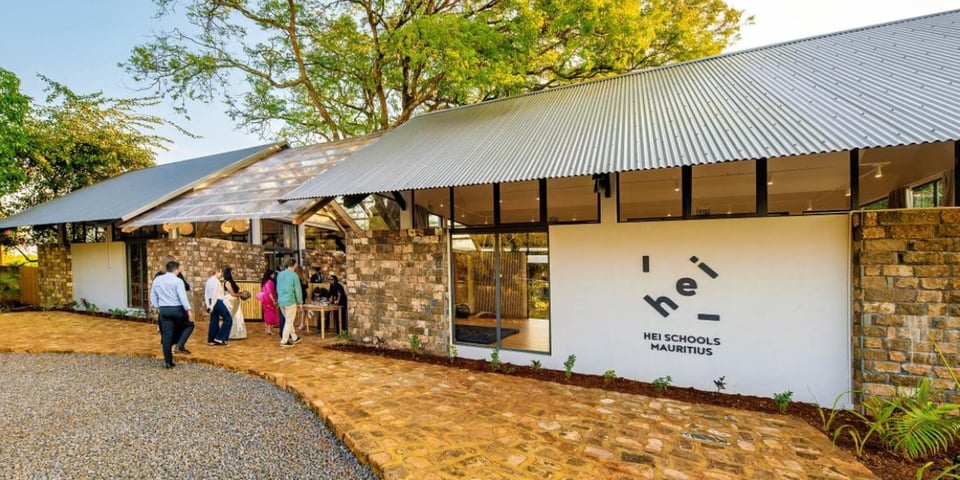
HEI Schools Partners with Local Change-maker to Open the First Finnish Preschool in Mauritius
Port Louis, Mauritius – August 29, 2025 – HEI Schools Mauritius has officially opened its doors as the first Finnish early education center in the country…

Looking for the Best Preschool Franchise in India? Here’s What Makes HEI Schools Different
Finland Tops Global Education Rankings. Now imagine that in your city. You’ve probably heard it before—Finland consistently ranks among the best education systems in the…
Montessori vs Finnish Education: Which Is Better for Preschoolers?
Choosing the right preschool approach is one of the most important decisions parents make during a child’s early years. Among the many educational philosophies available…